
The Arizona Attorney General’s Office is dedicated to a system of justice that is inclusive of crime victims and will remain vigilant in striving to provide the most efficient and effective service to the people of Arizona. The services provided to crime victims and the technical assistance and support provided to criminal justice agencies and other service providers is the responsibility of the Office of Victim Services.
The mission of the Attorney General’s Office of Victim Services is to promote justice and healing for people affected by crime in the state of Arizona. The Office of Victim Services is broken down into two primary facets, the advocacy and assistance provided to crime victims of cases prosecuted/argued by attorneys of the Attorney General’s Office and the leadership and agency support responsibilities that impact on the legal rights afforded to victims of crime in Arizona. These include: the Victims' Rights Program which provides financial assistance to criminal justice agencies, the Victims' Rights complaint process, and Victims' Rights Training.
MISSION
Promote justice and healing for people affected by crime in the state of Arizona.
VISION
Everyone in Victims’ Rights will be informed, trained, motivated, monitored, and accountable.
VALUES
Compassion. Teamwork. Integrity. Commitment. Flexibility. Trust.
MOTTO
Victims’ Rights: Every case, every time.
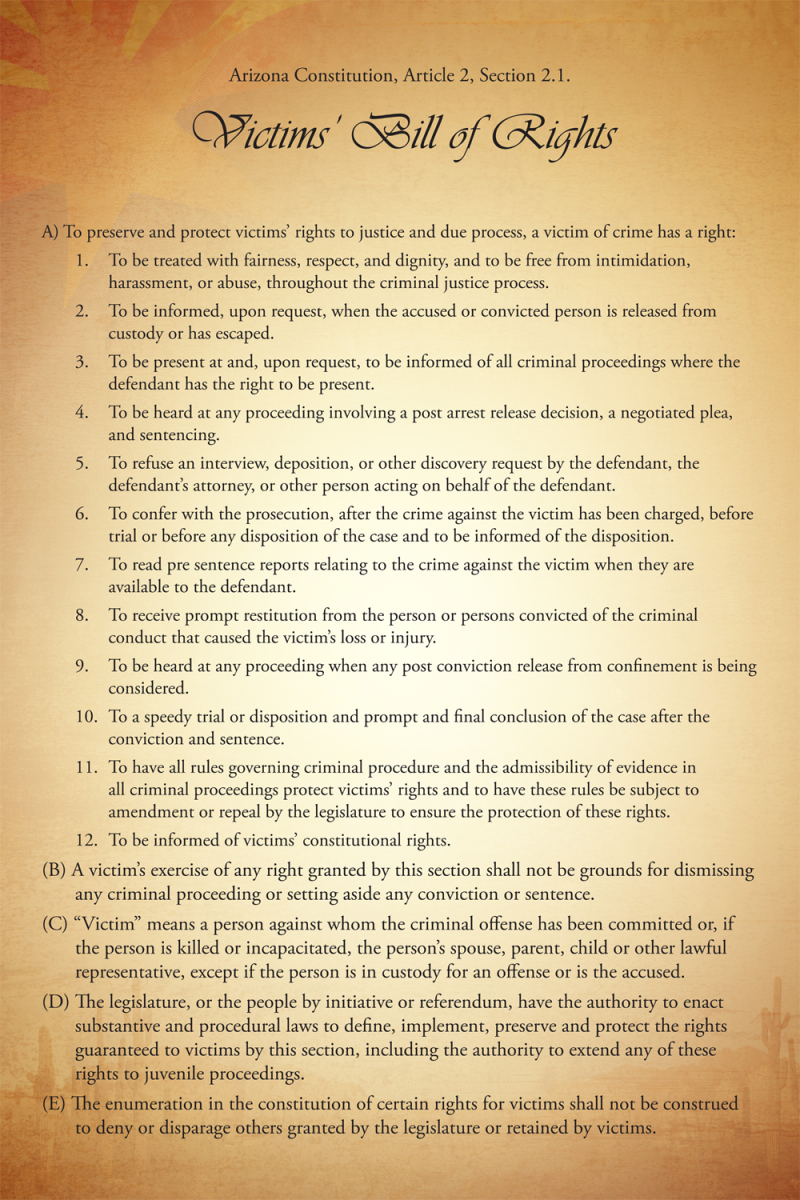
Below you will find a link to the current Arizona Victims' Rights Law Book compiled by the Office of Victims Services which contains the Victims' Bill of Rights. All Victims' Rights Statutes within the Arizona Revised Statutes according to title adult and juvenile restitution statutes, and other victim-related statutes. We have also provided links to the Arizona State Legislature website to view all Victims' Rights' laws.
2024 Arizona Victims' Rights Law Book
Who Is A Victim?
"Victim" means a person against whom the criminal offense has been committed, including a minor, or if the person is killed or incapacitated, the person's spouse, parent, child, grandparent or sibling, any other person related to the person by consanguinity or affinity to the second degree or any other lawful representative of the person, except if the person or the person's spouse, parent, child, grandparent, sibling, other person related to the person by consanguinity or affinity to the second degree or other lawful representative is in custody for an offense or is the accused. ( A.R.S. § 13-4401(19))
Criminal and juvenile justice statutes allow a victim who is physically or emotionally unable to exercise any right but is able to designate a lawful representative who is not a bona fide witness; the designated person may exercise the same rights that the victim is entitled to exercise. The victim may revoke this designation at any time and exercise his or her victim's rights.
If a victim is incompetent, deceased or otherwise incapable of designating another person to act in the victim's place, the court may appoint a lawful representative who is not a witness. If at any time the victim is no longer incompetent, incapacitated or otherwise incapable of acting, the victim may personally exercise his or her victim's rights.
Although legal entities and neighborhood associations can be considered victims, their rights under Arizona law are limited.
The Arizona Attorney General's Office does not discriminate on the basis of race, color, national origin, religion, sex, age, disability or sexual orientation in the delivery of services or employment. The Office of Victim Services is a sub-recipient of Victims of Crime Act (VOCA) funding through the Arizona Department of Public Safety and the US Department of Justice, Office for Victims of Crime. As a sub-recipient of federal funding, the OVS is required to notify employees, and actual & potential program participants (crime victims) of how they may file a discrimination complaint.
Employees may file a complaint with Human Resources at the Attorney General’s Office, with the Equal Employment Opportunity Commission (EEOC) at www.eeoc.gov (if an employee files a complaint to the EEOC then a complaint to the Office of Civil Rights is not required), or with any of the programs listed below.
Program participants may file a complaint with:
Office for Civil Rights
Office of Justice Programs
U.S. Dept. of Justice
810 7th Street, NW
Washington, DC 20531
In order to file with the federal Office for Civil Rights (OCR), two forms must be downloaded from the internet and submitted in writing to OCR. The forms can be found at www.ojp.gov/about/ocr/complaint.htm.
-and/or-
Arizona Department of Public Safety
VOCA Administration, MD3915
Civil Rights Coordinator
P.O. Box 6638
Phoenix, AZ 85005-6638
www.azdps.gov/services/government/crime-victims
-and/or-
Office of the Arizona Attorney General
Civil Rights Division
2005 N Central Avenue
Phoenix, AZ 85004
(602) 542-5263
https://www.azag.gov/complaints